The Revenue Impact of Poor Room Type Mapping
Most hotels believe their pricing problems come from demand, competition, or seasonality. Very few realise the real issue sits quietly inside their room type structure. Poor room type mapping doesn't just create confusion. It prints revenue all across direct bookings, OTAs, and even corporate contracts. And the worst part? It's often invisible in reports. Revenue managers attribute losses to market conditions when the actual problem is structural clarity.
What Room Type Mapping Really Means
Room type mapping isn't just about naming rooms. It's far more fundamental than that. It's about how room type categories are defined. How inclusions are communicated. How inventory is structured across channels. How guests understand the difference between options. Think of it as the foundational logic that connects your physical inventory to how guests perceive and choose from it. When this logic breaks, guests don't see value differences, what they see is price gaps. And price gaps without clarity kill conversions.
Consider a simple example. You have three room type: Standard, Deluxe, and Suite. But what makes a Deluxe worth 20% more than a Standard? Is it the view? The square footage? The amenities? The bed type? If a guest can't instantly answer that question by looking at your website or OTA listing, they won't pay the premium. Instead, they'll book the Standard and feel like they saved money.
How Guests Actually Choose Rooms
Here's the critical insight that most hoteliers miss: Guests don't compare room type the way hotels do. They don't analyse square footage. They don't study backend rate codes. They don't examine technical specifications. They scan:
- Room names. Is this called "Deluxe King" or "Superior Room"? Do those terms mean anything?
- Images. Does this room type look noticeably better than the other option?
- Inclusions. What comes with this room type that doesn't come with the cheaper one?
- Price differences. If I'm paying more, what am I actually getting?
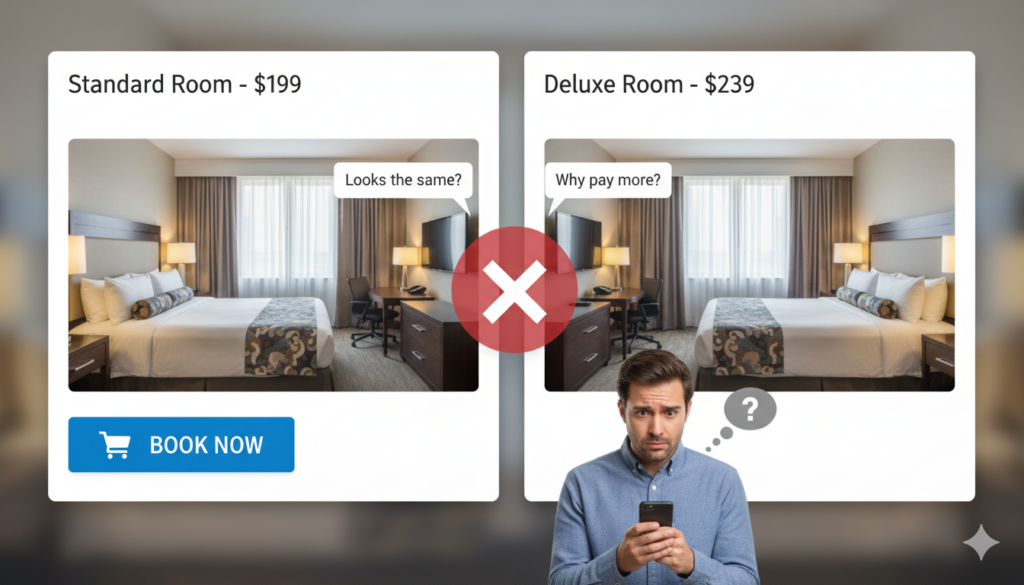
This scanning happens in seconds. Guests form quick impressions and move forward or abandon. Here's where it gets critical: If two room type look similar but are priced differently, one thing happens. They pick the cheaper one or they just leave entirely to shop elsewhere. That's not price sensitivity. That's confusing. And confusion is a revenue killer.
The Silent Loss in Upselling
Poor room mapping quietly destroys upsell potential in ways that don't show up obviously in your reports. When higher categories aren't clearly differentiated:
- Guests don't upgrade. If you can't justify why the premium room is worth the premium, they'll book the base category.
- Premium inventory sits unsold. Your suites and deluxe rooms stay empty while your standards are booked up.
- Average room rate drops even at high occupancy. You're selling more rooms, but at lower prices because your mix is all base categories.
Hotels then respond to this by discounting base categories, believing demand is weak. Occupancy is high, they think, so demand must be somewhere else. They slash rates on standards, creating a death spiral where everything needs discounting. In reality, demand is there but value communication isn't. Guests would upgrade if they understood what they were upgrading to. But because the mapping is unclear, they default to the lowest priced option.
OTAs Penalise You for Mapping Errors
Here's something most hoteliers don't fully appreciate: OTAs rely on clean room structures to optimise visibility and conversion. When your room types are overlapping, inconsistently named, mapped differently across channels, or missing a clear hierarchy, OTAs struggle to present them effectively. A typical example: You call a room "Deluxe King" on your website but "Superior King with City View" on Expedia and "Premium Accommodation" on Booking.com. The same physical room has three different names. OTA systems see this as potential confusion. They can't optimize for clarity. They don't know if these are the same room or different products. The result is predictable:
- Lower ranking. If OTA algorithms can't confidently categorise your inventory, they rank it lower in search results.
- Reduced conversion. Confused guests convert at lower rates.
- Aggressive discounting pressure. The OTA compensates for unclear positioning by offering discounts to drive bookings.
Not because your hotel is overpriced but because it's unclear. The platform doesn't know how to sell your product confidently, so it compensates with price.
Website Confusion Amplifies Distribution Problems
Your website should be where room logic is clearest. It should be your chance to tell your story, to justify your pricing, to help guests understand value. But in many cases, what actually happens is the opposite:
- Room descriptions are copied from OTAs. You haven't actually written your own narrative about why each room type matters.
- Images are reused without context. The photos don't clearly show what differentiates one category from another.
- Inclusions are buried in fine print. The guest has to hunt for information instead of having it presented clearly.
- Booking engines list rooms without guidance. You present five options with no recommendation, no visual hierarchy, no clear path to the right choice.
Instead of helping guests choose, the website forces them to guess. And when guests guess, they choose safety and not value. They pick the lowest price and move on. This is particularly damaging because your website is your owned channel. It's the only place where you have complete control over how your product is presented. When it's confusing, it damages not just direct bookings but your brand perception everywhere.
The Psychology of Price Gaps
Here's a psychological principle that applies powerfully to room type mapping: Unexplained differences feel suspicious. If two rooms look similar but have different prices, the guest's brain immediately tries to explain the gap. If you haven't provided that explanation clearly, they'll make up their own stories and usually the most pessimistic ones.
- "Maybe the cheaper room is noisier?"
- "Perhaps the expensive one is for suckers?"
- "Why would anyone pay more for what looks the same?"
These internal conversations happen subconsciously. The guest might not even realize they're happening. But they drive behavior. They suppress upgrades. They kill conversion on premium categories. Conversely, when price gaps are explained through clear visual, spatial, or experience differences, the guest accepts them. The premium room has a better view? That makes sense. Is the suite larger? Understandable. The deluxe includes breakfast? That justifies the cost. Clarity transforms price gaps from suspicious to reasonable.
Rate Parity Looks Broken When Mapping Is Broken
Hotels often chase parity issues that aren't actually pricing problems. They spend energy managing rate discrepancies across channels when the real issue is structural. When:
- Room names differ across channels. You call it one thing on your website and another on Expedia.
- Inclusions aren't aligned. Breakfast is included in one channel but not another.
- Packages aren't clearly defined. What makes a "Romance Package" different from a "Standard Deluxe"?
It looks like a parity violation even when rates are correct. The revenue manager panics. They assume there's a technical error or a competitor advantage. They adjust rates unnecessarily. All of this happens because the structure is flawed. Not the pricing. Not the strategy. The fundamental definition of what you're selling. This leads to unnecessary rate drops, overrides, and panic pricing. All chasing a problem that doesn't actually exist.
Corporate & Long-Stay Revenue Suffers Too
Room mapping issues don't stop at leisure bookings. They extend into your corporate and long-stay business and often your most profitable segments. Corporate buyers, travel managers, and long-stay guests want clarity. They need consistency. They expect standardisation. When room categories feel arbitrary or unclear, negotiations stall. The corporate buyer can't understand why your rates are structured the way they are. Your room types don't align with their needs. Your inclusions are confusing. Negotiations get pushed down as a result. If you can't articulate why your premium room is worth the premium, the buyer will push back on the rate. Structure builds confidence. Confidence protects rates. When a corporate buyer understands exactly what they're getting and why it justifies the cost, they move forward. When they're confused, they negotiate harder.
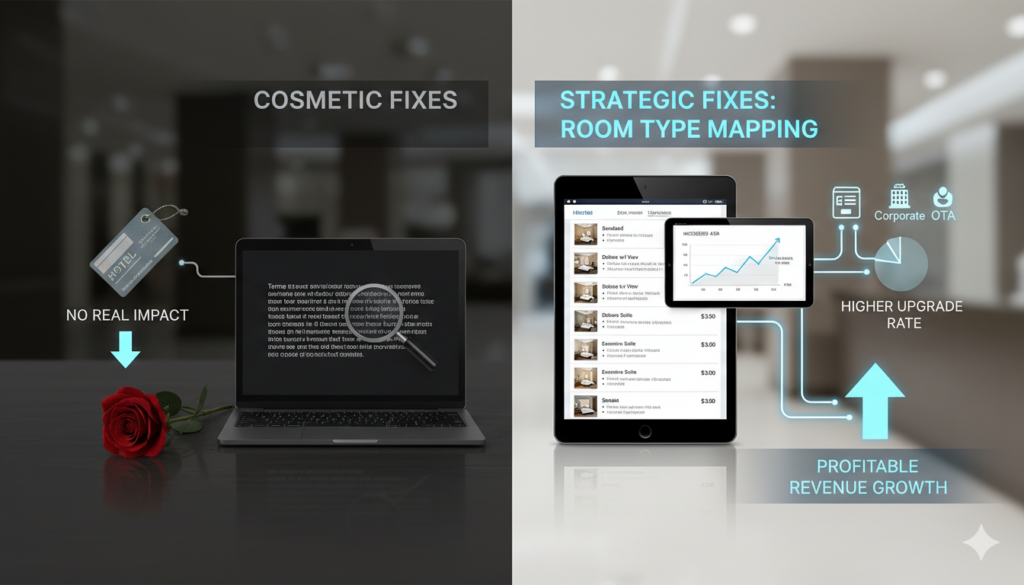
Fixing Room Mapping Is a Revenue Move, Not a Cosmetic One
Many hotel room types mapping as a minor operational detail. Something for the front desk to worry about. A housekeeping categorization system. It's not. It's a revenue strategy. Correct room type mapping:
- Improves conversion without discounts. Guests understand value. They book more readily.
- Increases upgrade uptake. Guests can see why premium rooms are worth the cost.
- Protects ADR. You're not discounting to move inventory because the right guests are booking the right categories.
- Reduces OTA pressure. Clear structures make OTAs' jobs easier, reducing their need to discount.
- Simplifies internal pricing decisions. When categories are clear, pricing them becomes logical.
- Strengthens corporate negotiations. Your structure is so clear that corporate buyers can't argue with it.
It's not about adding more room categories. You don't solve mapping problems by creating new room types. It's about making each one you have mean something distinct and defensible.
Where Strategy Quietly Meets Execution
The hotels that get room mapping right don't treat it as a one-time setup that's done and forgotten.
- They align room hierarchy with pricing logic. Each category step up has a clear reason and a clear price premium.
- They use content and images to justify price gaps. Photographs, descriptions, and inclusions combine to explain why one room costs more than another.
- They ensure consistency across PMS, CRS, OTAs, and websites. The same room is described the same way everywhere.
- They design booking flows that guide decisions. The booking engine doesn't just list options. It helps guests choose the right one.
When this happens, revenue performance improves without chasing demand. Without aggressive marketing. Without rate reductions. Because the problem was never demanded. It was an interpretation.
The Cost of Ignoring It
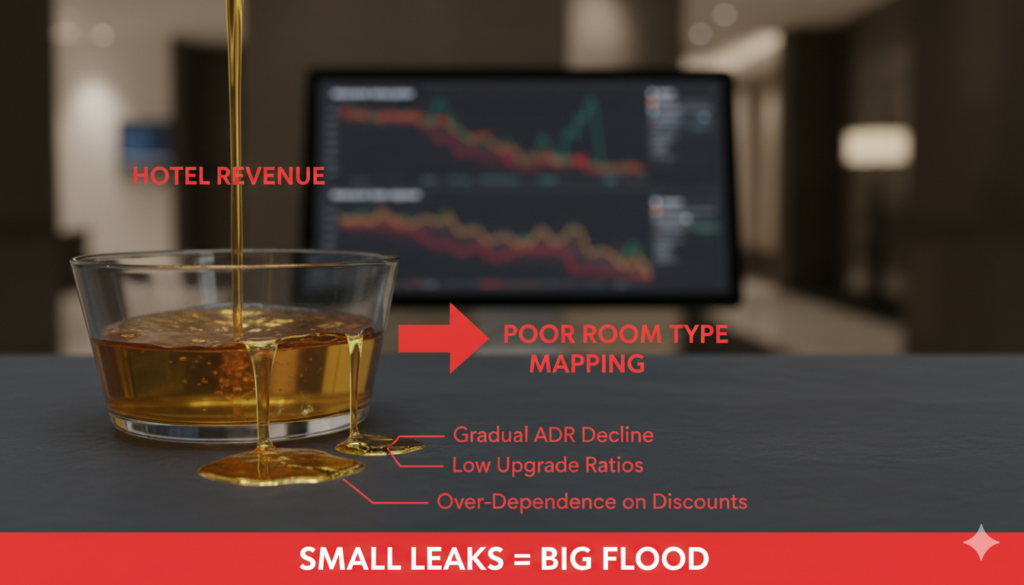
Poor room mapping rarely causes a sudden, dramatic drop in revenue. You don't wake up one day and lose 30% of bookings. Instead, it causes gradual erosion:
- Gradual ADR decline. Year over year, your average room rate slides down slightly.
- Low upgrade ratios. Most guests book your cheapest category.
- Over-dependence on discounts. You can't drive bookings without offering deals.
- Frustrated revenue teams. They feel like they're pushing a boulder uphill.
- Confused guests. Your booking experience feels complicated.
And by the time it's noticed, the losses feel "normal". Revenue managers accept that "this is just how the market is." They don't realise they're watching years of small leaks combine into a flood. They shouldn't be accepting this. It's fixable.
Clarity Is a Revenue Strategy
Hotels that grow profitably don't just price better. They communicate values better. Room type mapping is where that communication begins quietly, structurally, and powerfully. It's not flashy. It doesn't appear in marketing materials or revenue reports as "the big win." But it's there, working constantly, shaping how every guest understands what you're selling. And when it's done right, revenue stops leaking from places most hotels never thought to look.