Why Is My Hotel Occupancy High but Revenue Still Low?
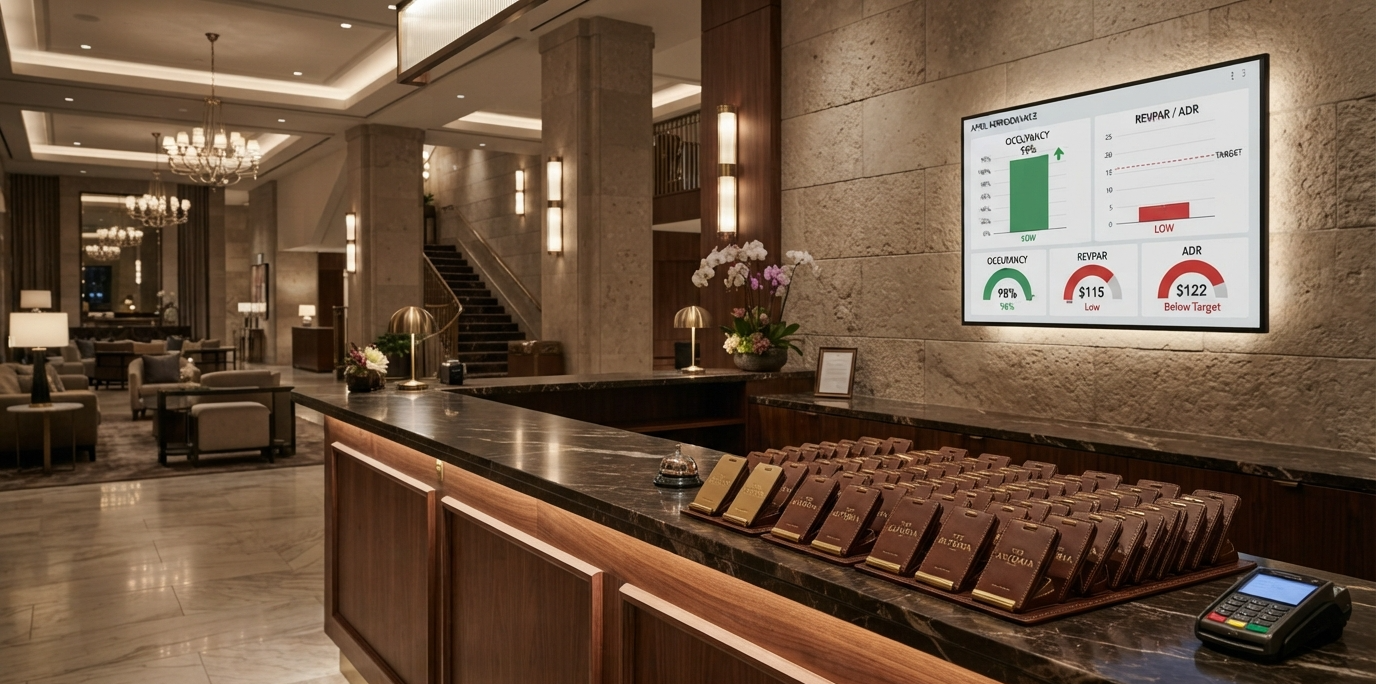
You check the front desk report and the numbers look great — rooms are full, the property feels alive, staff are running around servicing guests. Then you check the P&L and revenue is flat, or worse, down from last year. If this sounds familiar, you are not managing a demand problem. You are managing a pricing and distribution problem, and it is one of the most common blind spots in independent and mid-sized hotels.
It is also one of the easiest problems to miss, because every daily operations report is built around occupancy. Front desk teams, housekeeping schedules, and F&B forecasting all revolve around how many rooms are occupied tonight. None of that tells the owner or general manager whether the property made money doing it, and by the time the monthly P&L lands on the table, the underpriced month is already closed out.
High hotel occupancy feels like success because it is visible. A full lobby, a busy restaurant, guests checking in all evening — it looks like the business is winning. But occupancy is a volume metric, not a profitability metric. It tells you how many rooms sold. It says nothing about what those rooms sold for, who they sold to, or what it cost you to sell them. This gap between "rooms sold" and "money earned" is exactly where hotel revenue management earns its keep, and it is exactly where most independent properties are leaving money on the table.
Occupancy Tells You Half the Story
Occupancy is easy to track and easy to celebrate, which is why so many general managers and owners lean on it as the primary success metric. But a hotel running at 90% hotel occupancy on deeply discounted rates can generate less revenue than the same hotel at 65% occupancy with disciplined pricing. Two properties with identical occupancy numbers can have wildly different revenue outcomes depending on rate mix, channel mix, and length of stay.
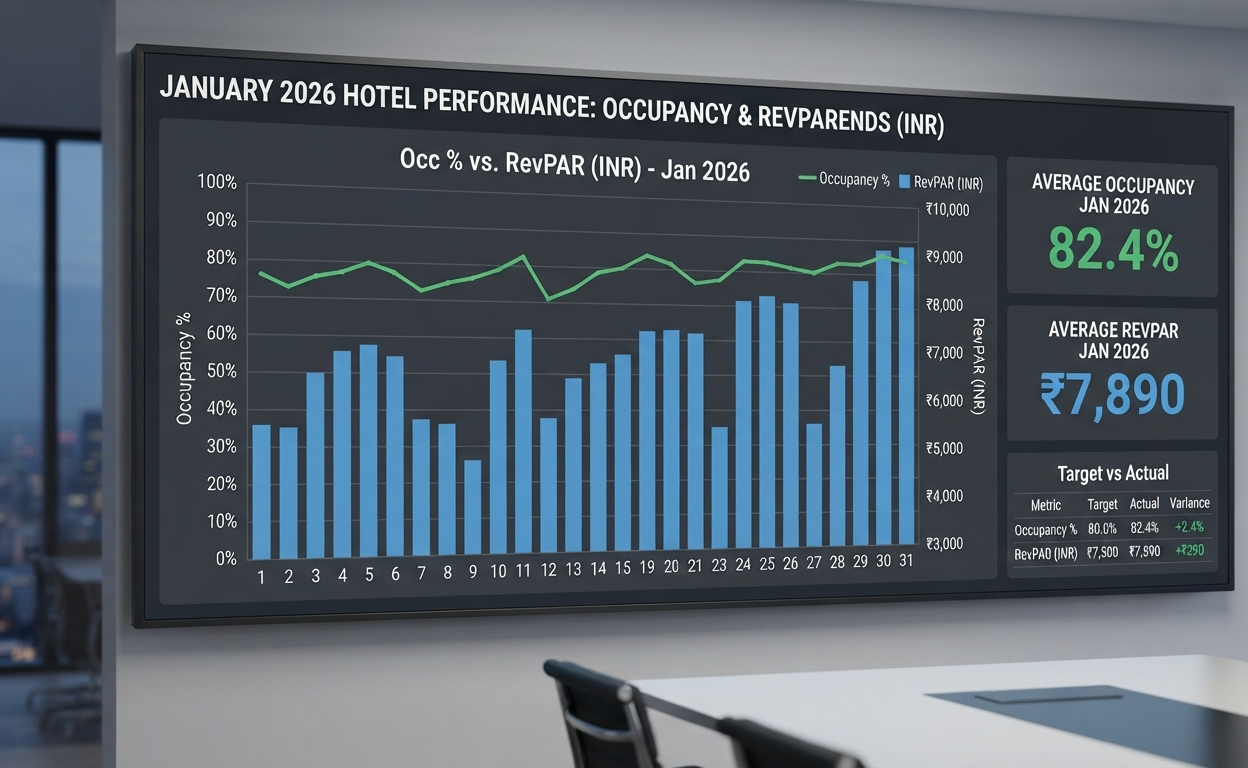
This is why revenue managers look past the occupancy percentage and straight at RevPAR — Revenue Per Available Room. It multiplies your occupancy rate by your average daily rate (ADR), giving you a single number that reflects both how full you are and how well you are being paid for it. A property fixated on filling rooms at any cost will often watch RevPAR stagnate even as the occupancy chart climbs, because every extra room sold is coming in at a lower rate than the last. Tracking RevPAR alongside occupancy is the fastest way to catch this pattern before it becomes a quarterly crisis.
Where the Revenue Actually Leaks Out
There are a handful of recurring reasons hotels see strong occupancy without matching revenue, and once you know what to look for, the pattern is usually easy to spot in your PMS data.
- Aggressive discounting to chase occupancy. When a property gets nervous about empty rooms, the fastest lever is usually a rate cut. It works — occupancy goes up — but the hotel has just trained the market to expect lower prices, and clawing that rate back later is far harder than lowering it was.
- Over-reliance on group and corporate blocks at flat rates. Group business is valuable for filling shoulder periods, but block rates are often negotiated months in advance and locked well below what transient demand would have paid on the same dates. High occupancy from group business can quietly cannibalise revenue that could have come from higher-paying individual travellers.
- Poor length-of-stay controls. Accepting a two-night booking during a high-demand weekend, when that same room could have sold as two separate one-night stays to two different guests at a higher blended rate, is a subtle but constant leak.
- Distribution mix skewed toward the cheapest channel. OTAs remain one of the most valuable acquisition channels a hotel has — they bring in guests a property would never reach organically, and the visibility they provide is genuinely hard to replace. The issue isn't the OTA relationship itself; it's when a hotel lets OTA-driven rate parity or promotional placements pull its overall rate positioning down across every channel, direct bookings included.
- No dynamic pricing discipline. Static rates that don't move with demand, day-of-week patterns, local events, or booking pace leave money on the table on high-demand dates and chase phantom demand on low-demand ones.
The Fix Is Hotel Revenue Optimisation, Not More Rooms Sold

Hotel revenue optimisation is the discipline of matching the right rate to the right guest, on the right channel, at the right time — so that every room sold is also a room sold well. It is a mindset shift away from "how do we fill the hotel" and toward "how do we maximise what the hotel earns while staying full enough to run efficiently." Full occupancy is a byproduct of good hotel revenue optimisation, not the goal of it.
In practice this means segmenting demand properly. A leisure traveller booking three months out, a corporate guest booking three days out, and a last-minute weekend walk-in all have different price sensitivity, and treating them identically with one flat rate ignores that reality. It also means building rate floors that protect your ADR even during low-demand periods, so a slow Tuesday doesn't turn into a race-to-the-bottom rate that then becomes the market's new reference price.
Practical Steps to Increase Hotel Revenue Without Sacrificing Occupancy
The good news is that fixing this doesn't require lowering occupancy. It requires being more deliberate about how that occupancy is earned.
- Set and defend rate floors by season and day-of-week. Know the minimum rate that still makes a room profitable once you account for OTA commissions, distribution costs, and operational cost per occupied room. Never sell below it out of panic.
- Rebalance your channel mix. Push harder on direct bookings through your website and voice/WhatsApp channels where commission costs are lower, while still treating OTAs as legitimate demand-generation partners rather than a channel to be minimised entirely.
- Use length-of-stay and minimum-stay restrictions strategically. On high-demand dates, restrict short stays that block out higher-value bookings around them.
- Review group and corporate rates quarterly. Rates negotiated a year ago rarely reflect current market conditions. Renegotiate or reposition stale contracts before they eat into peak-season revenue.
- Build a real forecasting habit. Compare booking pace against the same period last year and adjust pricing proactively instead of reactively discounting when a date looks soft.
- Upsell and cross-sell at every touchpoint. Room upgrades, early check-in, breakfast add-ons, and spa or dining packages increase revenue per guest without needing a single additional room sold — a direct way to increase hotel revenue that doesn't depend on rate changes at all.
Each of these actions individually moves the needle. Together, they are what separates a property that happens to be full from a property that is deliberately, sustainably profitable.
A Quick Example

Take two identical 40-room properties in the same city, same week. Property A closes the month at 88% hotel occupancy with an average rate of ₹4,200. Property B closes at 71% hotel occupancy with an average rate of ₹5,800. On paper, Property A looks like the stronger performer — more rooms sold, a fuller-looking hotel, happier housekeeping team. But run the RevPAR numbers and Property B comes out ahead, earning more per available room while running fewer nights of turnover, lower utility load, and less wear on the property.
Property A didn't do anything wrong operationally. It simply chased occupancy without a rate strategy behind it, likely leaning on aggressive OTA promotions and flat-rate group blocks to keep the numbers up. Property B applied basic hotel revenue optimisation — holding rate floors, segmenting demand, and letting a slightly lower occupancy number sit at a much healthier price point. This is the exact comparison every owner should be running monthly, not just at year-end, because it's the fastest way to see whether the team is filling rooms or actually finding ways to increase hotel revenue.
Why This Needs Ongoing Hotel Revenue Management, Not a One-Time Fix
The instinct after reading a list like this is to make a few changes and move on. But market conditions, competitor pricing, seasonality, and demand patterns shift constantly, which is exactly why hotel revenue management has to be a continuous discipline rather than a quarterly project. A rate floor that made sense in April can be wrong by August. A channel mix that worked before a new competitor opened nearby can quietly start underperforming without anyone noticing until the numbers are reviewed.
This is also why this work increasingly sits with a dedicated function — whether in-house or through a consulting partner — rather than being an occasional task squeezed into a general manager's already full schedule. The properties that consistently post strong revenue, not just strong occupancy, are the ones that treat pricing and distribution as an active, data-driven job every single week.
The Real Metric to Watch
If there is one habit to take away from this, it's to stop reporting occupancy in isolation. Pair every occupancy number with RevPAR, and pair that figure with a channel-mix breakdown. That combination tells you not just how full the hotel was, but how well it was paid for being full — and it's the clearest early warning system for exactly the problem this article started with: high occupancy that isn't translating into the revenue it should.
Getting this right consistently is less about any single tactic and more about having a structured hotel revenue management approach behind every pricing decision. That's the gap most independent hotels are actually dealing with when occupancy looks great on paper but the bank balance doesn't follow.
Frequently Asked Questions
Is high hotel occupancy always a good sign?
Not on its own — it's only a good sign when it's paired with a healthy average rate. Occupancy achieved through steep discounting or over-reliance on low-yield group blocks can actually mask a revenue problem rather than solve one.
What's the fastest way to increase hotel revenue this quarter?
Start with rate floor discipline and length-of-stay controls before touching anything else — they require no new technology or budget, and most properties see a measurable lift within a single billing cycle. Upselling at check-in is the next fastest way to increase hotel revenue without changing your published rates at all.
Do I need software for this, or can it be done manually?
A spreadsheet and a weekly forecasting habit can get a small independent property most of the way there. Dedicated hotel revenue optimisation tools help at scale, particularly across multiple properties, but the underlying discipline — segmenting demand, defending rate floors, reviewing channel mix — matters more than the tool used to apply it.
How often should I review my hotel revenue management strategy?
Weekly for pricing and booking pace, monthly for channel mix and group contracts, and quarterly for a full strategic review against competitor sets and market conditions. A discipline that only gets attention once a year is reactive by definition.