Hotel Revenue Management for Small Hotels: A Practical Guide to Growing Room Revenue
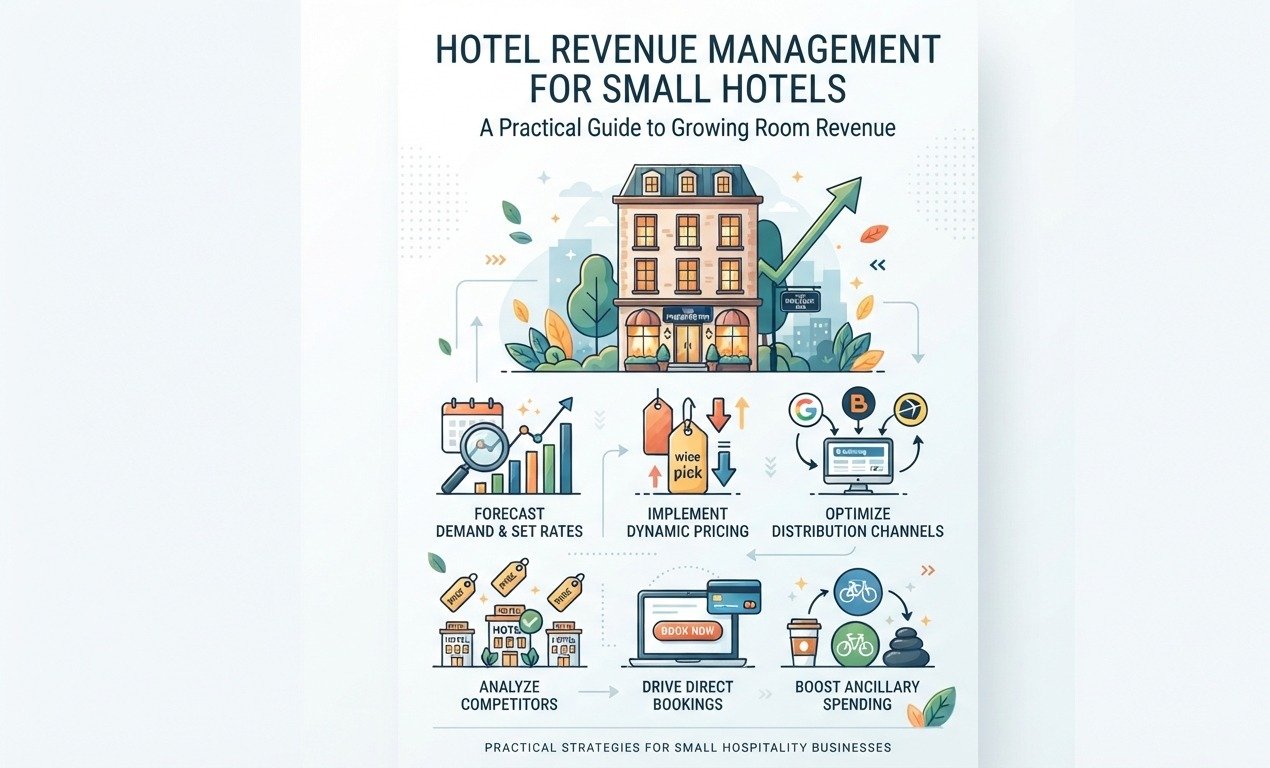
Hotel Revenue Management for Small Hotels starts with one simple idea: every room should be sold at the right price, to the right guest, at the right time. For smaller properties, revenue management does not need a complicated system. It needs clear pricing decisions based on demand, booking patterns, market conditions, and the inventory already available.
Many small hotels still depend on fixed rates or last year’s pricing. That approach may be easy to maintain, but it can miss changes in demand. A room that sells for the same price on a quiet Tuesday and a high-demand Saturday is not being priced according to the value of that inventory.
Why Small Hotels Need Revenue Management
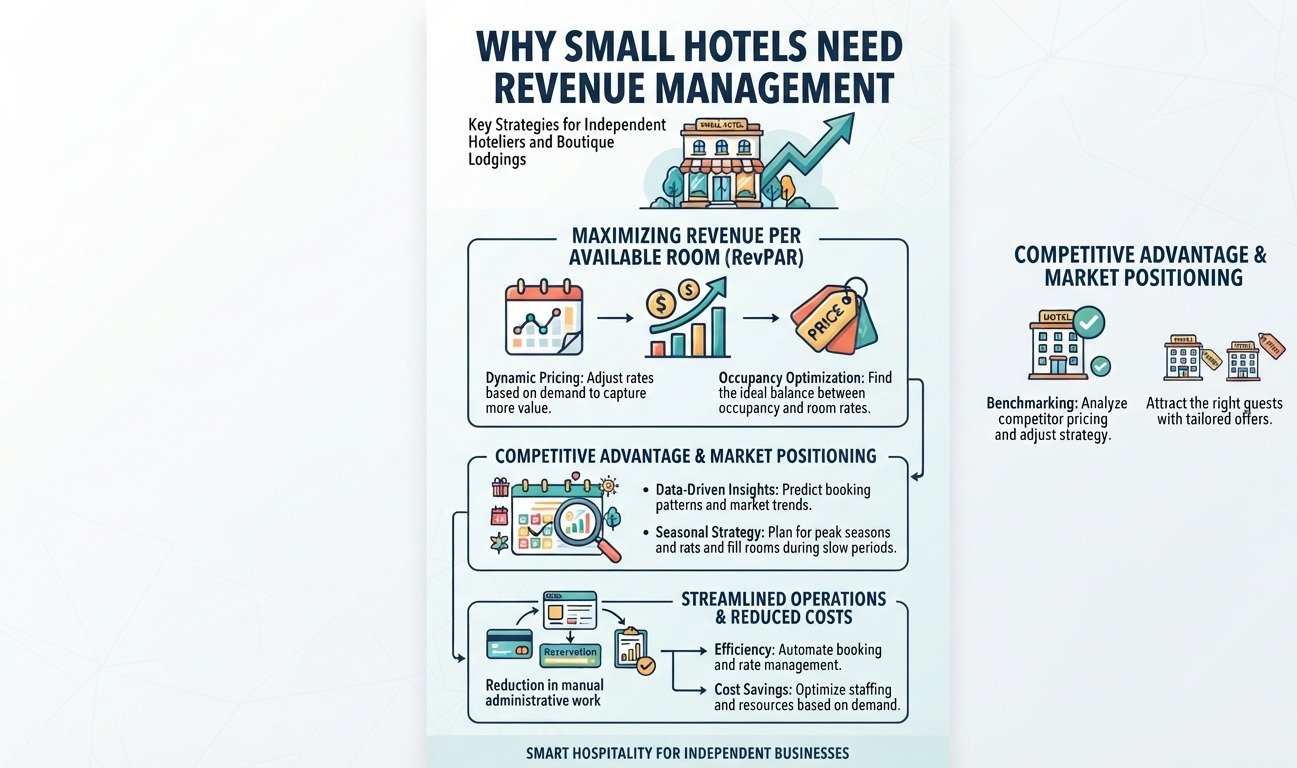
A small hotel has fewer rooms, so each room night has a greater impact on monthly revenue. If a 40-room property sells rooms too cheaply on a high-demand weekend, that opportunity cannot be recovered later because the inventory for that night is limited.
Small teams also handle multiple responsibilities at once. Revenue, reservations, front office, sales, and marketing may involve only a few people. A practical revenue process helps reduce guesswork and keeps attention on the decisions that directly affect room revenue.
Revenue management is also about more than occupancy. A hotel can be highly occupied and still underperform because its rooms were sold at weak rates. The goal is to balance occupancy, average room rate, and overall room revenue instead of chasing full occupancy at any price.
Understand Your Booking Patterns
Before changing prices, study how demand behaves at your property. Review bookings by day of week, month, season, room type, booking source, lead time, length of stay, and cancellation pattern. Even a simple spreadsheet can reveal useful trends when the data is reviewed consistently.
For instance, a hotel may find that weekend bookings begin accelerating a week before arrival, while weekday demand is often more last-minute. That difference should influence pricing decisions. A single rate strategy applied across every day can make a property less responsive to actual guest behaviour.
Identify high- and low-demand periods as well. High-demand dates may be linked to holidays, exhibitions, weddings, festivals, or local events. Softer dates may need targeted offers, packages, or carefully adjusted rates rather than permanent discounts.
Set Rates According to Demand
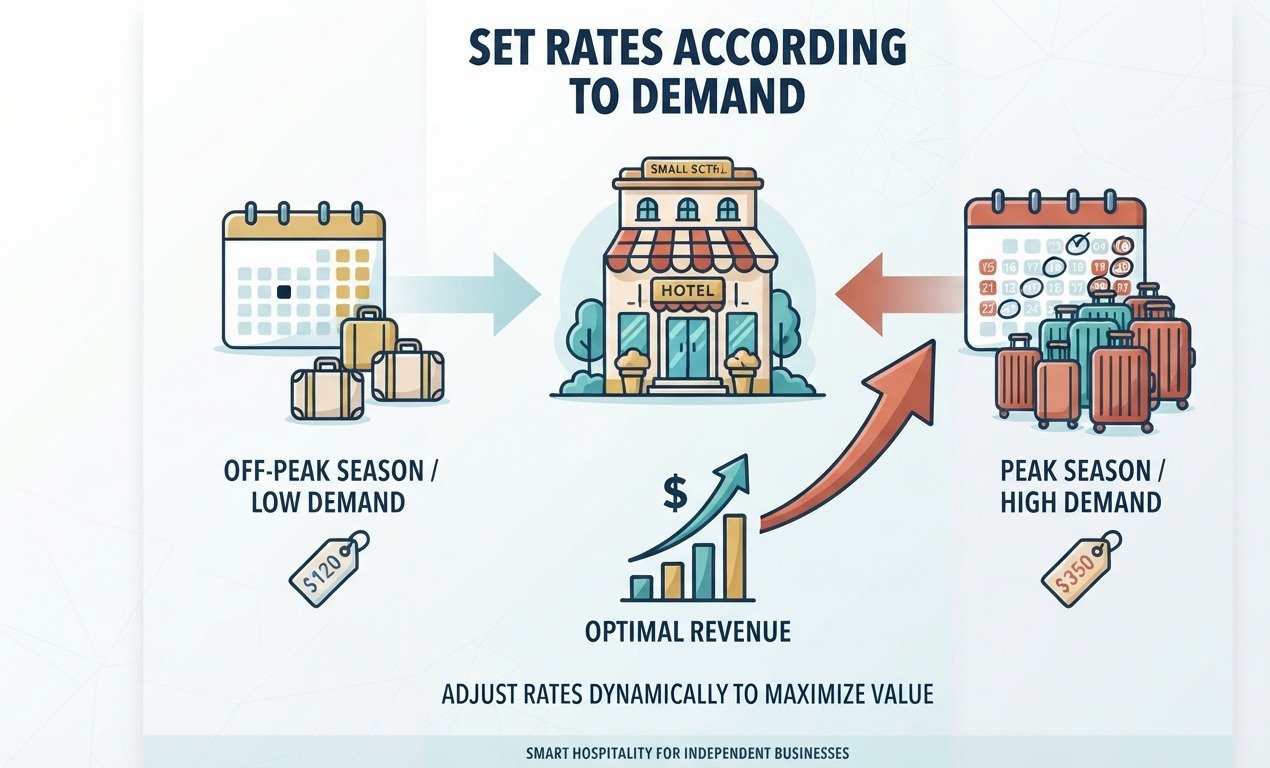
Pricing should respond to demand, not only to operating costs. A small hotel can build a simple rate structure with a base rate and several pricing levels that move up or down according to expected demand. This keeps the process manageable while creating room for adjustment.
When bookings are accelerating and availability is falling, rates can be increased gradually. When demand is soft, rates may be adjusted to encourage bookings while still protecting the hotel’s minimum acceptable rate. This is more controlled than offering discounts whenever occupancy looks weak.
Rates should also be reviewed regularly. A price that made sense at the start of the week may become outdated if bookings suddenly accelerate. A short daily review during busy periods, supported by a weekly review during normal periods, can keep pricing active.
How Dynamic Pricing Helps Small Hotels
Dynamic pricing for hotels does not mean changing rates randomly. It means adjusting prices as booking conditions change. The aim is to react to real demand signals early enough to protect revenue and use remaining inventory effectively.
Imagine a 50-room hotel with weak bookings for an upcoming Friday. It may hold its base rate or test a value-focused offer. If bookings then accelerate and only a small number of rooms remain, keeping the same low rate may miss an opportunity to earn more from the remaining inventory.
The number of rate levels is less important than the logic behind them. A small hotel can start with simple rules based on occupancy, booking pace, days to arrival, and market demand, then make the approach more detailed as it builds a stronger data history.
Monitor Competitor Pricing
Competitor analysis is useful, but copying competitor rates is not a strategy. Small hotels should compare themselves with properties that are genuinely relevant in terms of location, room type, guest segment, facilities, and overall positioning.
Review competitor rates for comparable dates and note what is included. Breakfast, cancellation terms, parking, transfers, views, or other inclusions can affect perceived value. A lower room rate does not automatically mean a more competitive offer.
The goal is to understand market position. If a property consistently prices below comparable hotels during strong demand, it may be missing a pricing opportunity. If it prices above the market without a clear value difference, conversion may become harder.
Forecast Occupancy and Revenue
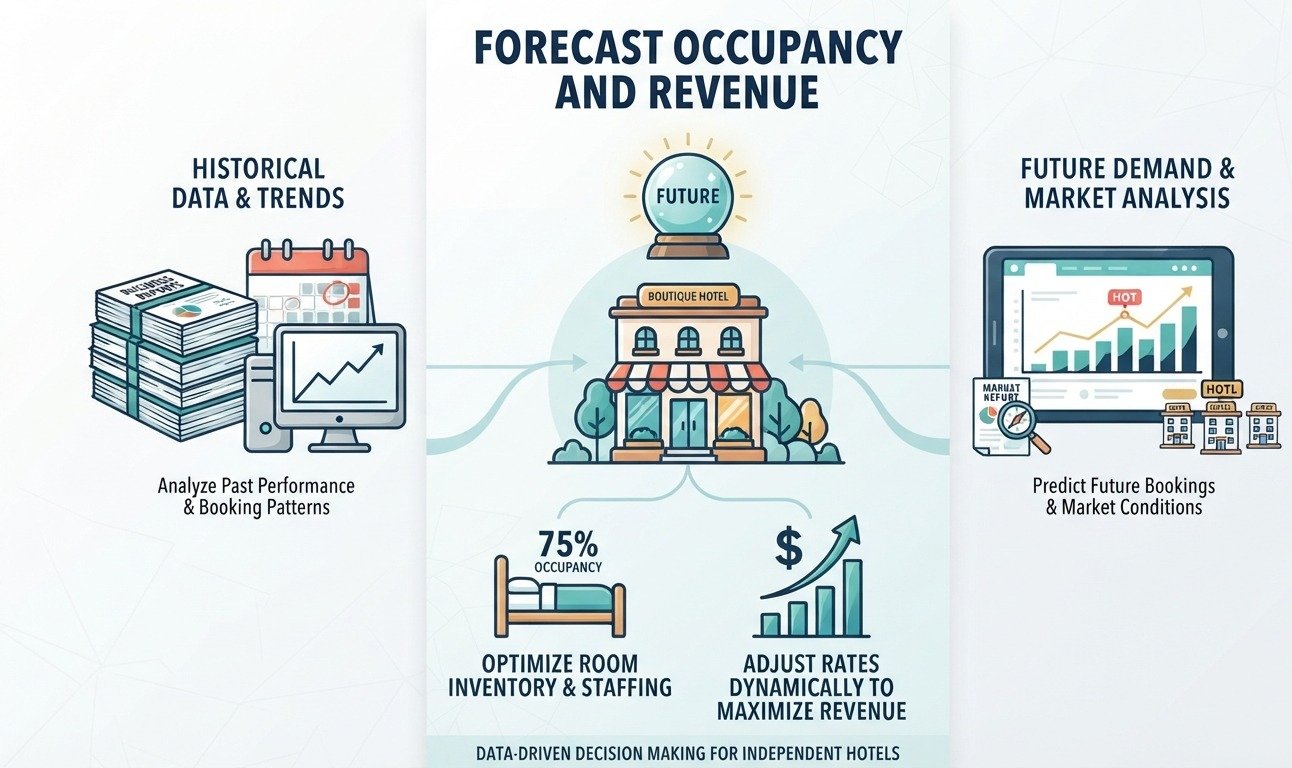
Forecasting does not need to begin with complex software. A small hotel can combine current bookings, recent booking pace, historical patterns, expected events, and available rooms to create a useful forward view.
Compare current on-the-books bookings with similar periods from previous years and with recent pickup patterns. This can help identify dates that look stronger, weaker, or uncertain. Each group can then receive different pricing, sales, distribution, or marketing attention.
A forecast becomes more useful when it is updated regularly. Every new booking changes the picture. Weekly forecast reviews can help a small hotel identify changes early enough to adjust rates, restrictions, packages, or channel availability.
Do Not Measure Performance Through Occupancy Alone
Occupancy shows how much inventory has been sold, but not whether it was sold at the right rate. A hotel may reach 90% occupancy at a low average room rate and generate less room revenue than a scenario with slightly lower occupancy and stronger pricing.
That is why small hotels should look at multiple measures together. Average Daily Rate indicates what the hotel earns per occupied room, while RevPAR connects room rate and occupancy to show room revenue performance across available inventory.
Year-on-year comparison also needs context. Growing from last year is useful information, but it does not prove that all revenue opportunities were captured. Compare actual performance with the hotel’s targets and expected demand as well.
Manage Room Types and Inventory
Revenue management is not limited to one property-wide rate. Different room categories can have different demand patterns, and the price gap between categories should make commercial sense.
If standard rooms sell quickly while premium rooms remain available, review the rate difference, room presentation, inclusions, and availability. During high-demand periods, protecting higher-value categories can also help the hotel improve the overall value of each booking.
Inventory controls matter too. A hotel can decide when to close lower-rate offers, limit promotional availability, or introduce minimum-stay rules for peak dates. These controls help prevent valuable rooms from being committed too early at lower prices.
Use OTAs as Part of the Distribution Mix
Online travel agencies can help small hotels reach guests beyond their immediate market. The objective is not to avoid OTAs, but to understand where they add value and manage their contribution to the overall distribution mix.
Track bookings by channel, achieved rate, cancellation behaviour, lead time, and demand period. This helps the property understand which channels support volume, which support stronger rates, and when channel exposure is most useful.
The right distribution mix changes with demand. During softer periods, an OTA may provide useful visibility and booking volume. During high-demand periods, the hotel may have more flexibility to protect rate and manage availability across channels.
Build a Simple Revenue Review Routine
A small hotel does not need a large revenue department to create pricing discipline. It needs a repeatable review routine. Review upcoming occupancy, booking pace, average rate, competitor pricing, events, cancellations, and the next set of high- and low-demand dates.
Daily checks can be valuable during peak periods when bookings change quickly. During normal periods, a structured weekly review may be sufficient to keep pricing decisions active instead of leaving rates unchanged for long stretches.
Record the reasons behind major pricing changes as well. Over time, those notes create a simple learning system. The team can compare the original expectation with actual booking results and improve the approach based on what the market actually did.
Avoid Common Revenue Management Mistakes
One common mistake is leaving rates unchanged for too long. Fixed pricing may feel predictable, but it does not respond to changing demand. Another mistake is discounting immediately when occupancy is low without first checking booking pace, market conditions, and days remaining before arrival.
Small hotels can also overreact to competitors. A competing property may change its rate because of a different strategy, different room product, or different demand pattern. Matching that price automatically can weaken revenue without addressing the actual reason for slower bookings.
Another mistake is focusing only on monthly reports. Monthly reports explain what happened, while revenue management is mainly about improving decisions before the stay date. The earlier a hotel identifies a pricing opportunity, the more options it usually has.
Use Technology Without Adding Complexity
Technology can make revenue management easier for a small property. A PMS can provide booking and occupancy information, a channel manager can help maintain rates and inventory, and revenue tools can support recommendations and reporting.
Technology, however, should support commercial judgment rather than replace it. Data can highlight changes in pickup, availability, or competitor pricing, but the hotel still needs to understand its positioning and demand.
The best setup is often the one the team can use consistently. A simple system that delivers clear information is more valuable than a complex system that adds work and is rarely reviewed.
Build a Practical Small Hotel Revenue Strategy
A practical small hotel revenue strategy can start with a few questions: Which dates are strongest? When do bookings usually arrive? Which room types sell first? Which channels perform well? How is the property positioned against relevant competitors?
The answers can then be turned into simple rules for base rates, pricing levels, review frequency, minimum rates, and high-demand controls. The hotel can also decide what specific signals should trigger a pricing change, such as faster-than-expected pickup or a sharp fall in available inventory.
The strategy should remain flexible. Demand changes, events shift, guest behaviour evolves, and competitors adjust their offers. A useful strategy is therefore a working process that becomes more accurate as the property collects and reviews more data.
Improve Revenue From Existing Inventory
One of the strongest benefits of revenue management is that it focuses on improving the value of rooms the hotel already has. A small property may not be able to add rooms or increase demand overnight, but it can improve how those rooms are priced, distributed, and sold.
Better pricing can help capture more revenue on strong dates while supporting demand on weaker dates. Better forecasting can reduce last-minute reactions. Better competitor analysis can clarify market position. Better reporting can show which decisions are contributing to results.
This makes revenue management an ongoing commercial function rather than a one-time pricing exercise. It connects demand, inventory, distribution, and pricing so that each available room night can be managed with greater purpose.
Final Takeaway
Hotel Revenue Management for Small Hotels does not require a large team or a complicated system. It requires consistent attention to demand, booking pace, pricing, competition, inventory, and performance metrics.
A useful starting point is simple: understand booking patterns, create pricing rules, review future demand, monitor comparable hotels, and adjust rates before the market makes the decision for you.
When these practices become part of regular hotel operations, revenue decisions become more structured and less reactive. For a small property, that discipline can improve room revenue without requiring more rooms, constant discounting, or a larger team.